

Sector Expertise
Every energy-intensive process wastes heat differently, and every process needs a different solution. We focus on three sectors where we've built up real technical expertise: precast concrete, ceramics, and food manufacturing. Here's some of what we've learned about each of them, and where the industry's attention needs to focus.
PRECAST CONCRETE
The Sector
Precast concrete manufacturing depends on curing: loading freshly mixed concrete on pallets at an elevated temperature for a set period so it gains strength from its hydration reaction, before unloading and packaging. That heat is usually supplied by hot air or water, circulated around the curing chambers, either as a batch process or continuous operation.
Many precast sites, particularly those in rural locations, have no connection to the mains gas supply and heat is generated using fuel oil or LPG boilers, with higher costs and carbon emissions.

Decarbonisation in Precast Concrete
Because curing temperatures typically sit in the 35–40°C range, this is well within the operating envelope of high temperature air source heat pumps. That makes precast concrete one of the more straightforward sectors to decarbonise: the heat pump technology is well suited to the process of continuous or batch curing on a schedule.
For sites already running on fuel oil or LPG rather than mains gas, the economics of switching to zero carbon electricity are often more favourable.
How We Bring the Change
First, we assess your curing process, by understanding your chamber construction, curing cycles, heating system, loading patterns, current fuel usage and cost. Where a phased approach is required to demonstrate the switchover, we'll convert one production line or factory area first, prove the numbers, and scale from there, exactly how our first precast concrete project was delivered.
Thermal buffer tanks are built into the design where the curing schedule can support it, so you're not just switching fuel, you're using the heat in an optimised way.
CERAMICS
The Sector
Ceramics manufacturing, whether that's brick, tile, tableware or technical ceramics, runs on two distinct thermal stages. Drying removes moisture from the formed clay or granulated material after it is moulded and before it is loaded into the kiln, usually at temperatures up to 90 °C. Firing is the high-temperature stage, up to 1250 °C, where the product gains its final strength and characteristics.
Firing is also where ceramics differs from most other energy-intensive sectors. A large percentage of its carbon emissions don't come from just burning the gas fuel, they come from the chemical decomposition of carbonates in the raw material itself during firing. That's a process emission, not a combustion emission, and no amount of fuel switching removes it.

Decarbonisation in Ceramics
This dual-emissions reality matters because it shapes what's realistic right now. Electrifying kilns is extremely difficult: the flame itself is often part of the chemistry that gives the product its properties, oxygen availability and flame characteristics influence material transformation, and for many products there's currently no commercially viable low-carbon kiln at production scale. Full kiln electrification, where it's even possible, means replacing the kiln outright, not retrofitting it.
Drying is a different story. It typically runs at far lower temperatures than firing, and in batch dryers specifically, a large proportion of the heat generated, up to 90% in some cases is exhausted rather than reused. That's recoverable heat technically and commercially proven to be reused back into the process.
What Gets Missed
First, we assess your curing process, by understanding your chamber construction, curing cycles, heating system, loading patterns, current fuel usage and cost. Where a phased approach is required to demonstrate the switchover, we'll convert one production line or factory area first, prove the numbers, and scale from there, exactly how our first precast concrete project was delivered.
Thermal buffer tanks are built into the design where the curing schedule can support it, so you're not just switching fuel, you're using the heat in an optimised way.
How We Bring the Change
We're not going to tell you we can electrify your kiln or capture your carbon emissions, because for ceramics processes, this is technology is not yet available. What we do is find the heat that's already being wasted around the kiln, in exhaust streams and drying chambers, and put it to work through heat recovery and high temperature heat pumps, delivering a real payback now rather than a promise tied to hydrogen infrastructure, carbon capture or next-generation kiln technology that's still years away. It's a smaller claim than "decarbonise your kiln", and it's one we can deliver today.
FOOD MANUFACTURING
The Sector
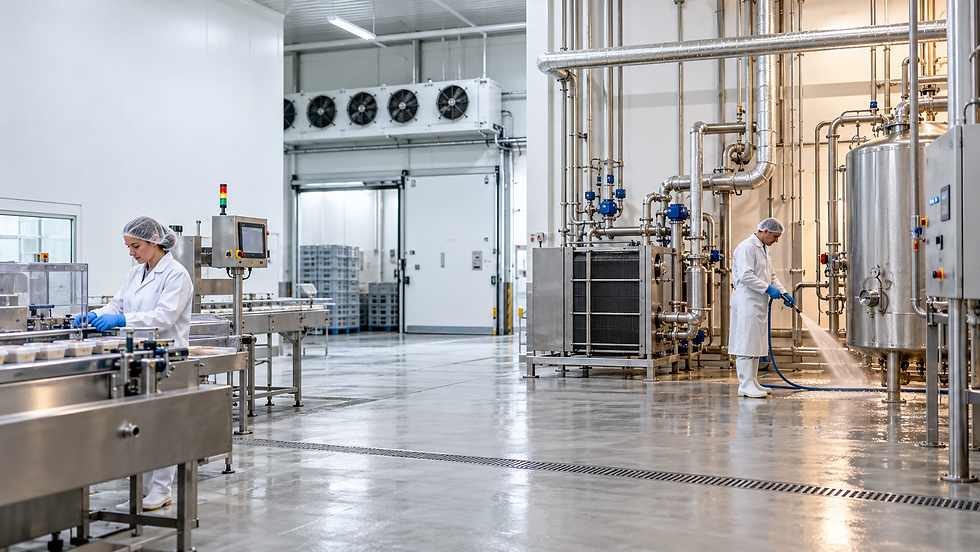
Food manufacturing is unusual in that most sites run heating and cooling at the same time. Cooking, baking, blanching, pasteurising and sterilising all demand consistent process heat, often from gas-fired boilers or ovens, while the same site is simultaneously running refrigeration and chilling to keep raw material and finished product safe.
Hygiene requirements shape everything here. Any change to plant or process has to account for food-safe materials, cleaning-in-place cycles, and allergen control, which makes food manufacturing a sector where the engineering has to fit around compliance, not the other way round.
Decarbonisation in Food Manufacturing
The simultaneous heating and cooling demand is the sector's biggest opportunity. Refrigeration and chilling systems reject heat as a by-product, heat that's usually just discarded, while elsewhere on the same site, hot water or low-grade heating is being generated using gas boilers. Recovering reject heat from refrigeration and redirecting it to hot water, pre-heating or space heating is a well-established technique in food and drink processing, and it doesn't require replacing your core production equipment.
What Gets Missed
Most food sites think about decarbonisation as "replace the boiler" and stop there. That misses the heat already being generated and thrown away on the cooling side of the same operation. The opportunity isn't always about installing something new to capture heat from a process, it's often about connecting two systems on the same site that were never designed to work together.
How We Bring the Change
We map your site's full thermal picture, where heat is being used, and where it's being rejected, before recommending anything. Because hygiene and cleaning schedules are non-negotiable, any installation is planned around your existing compliance and production calendar, not against it. Where reject heat from refrigeration can be captured and reused elsewhere on site, that's usually the fastest, lowest-disruption win available.
ONE APPROACH, MANY SECTORS
Precast concrete, ceramics and food manufacturing look like very different industries. Underneath the process, they're often solving the same problem: heat is being generated somewhere on site and lost, while heat is being bought somewhere else on the same site, at cost.
That's why an approach that works in one sector is frequently transferable to another. A thermal storage strategy proven in precast concrete curing can apply just as well to a batch process in food manufacturing. A drying-stage heat pump proven in ceramics can suit any process with a similar temperature and moisture profile, regardless of what's actually being made.
We've built our expertise across these three sectors deliberately, because seeing the same underlying pattern play out in different industries is what lets us move quickly and accurately when we look at a new site, even one outside these three.

Don't see your sector listed? That doesn't mean we can't help.
Waste heat doesn't care what industry you're in, and neither does the engineering that recovers it. If your process generates heat that isn't being reused, get in touch and we'll tell you honestly what's possible on your site.