

About Us
Heatcatcher was founded in 2009 by CEO Darren Bryant. After 15 years delivering energy-saving heating, ventilation and air conditioning (HVAC) projects in large commercial buildings, Darren saw a much bigger opportunity for energy efficiency in energy-intensive industries.
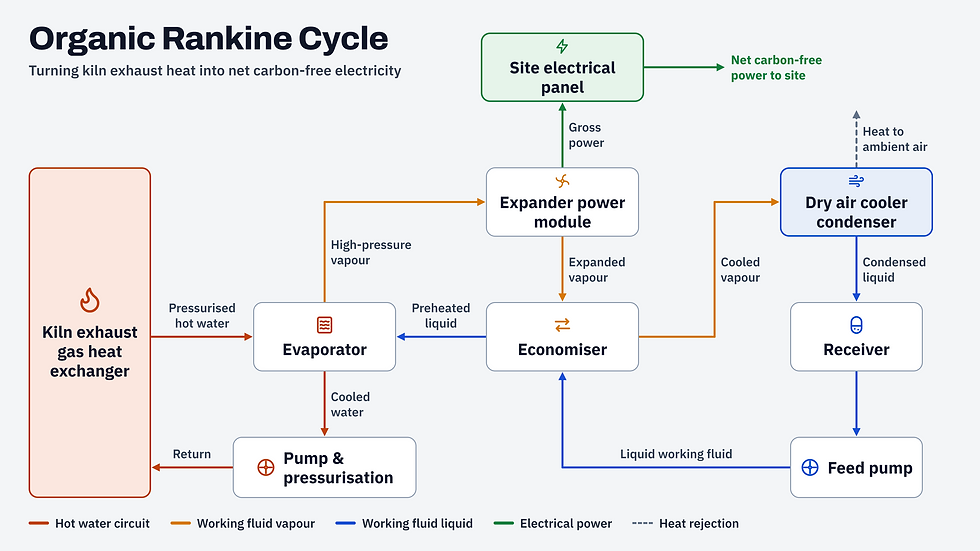
The problem he set out to solve was how the waste heat lost from the stacks of kilns, furnaces and boilers could be converted into zero-carbon electricity. After a two-year “Industrial Waste Heat to Electricity” programme under a Knowledge Transfer Partnership with the University of Brighton, Heatcatcher secured its first £1.2m project: the UK’s first waste heat recovery system to generate electricity using Organic Rankine Cycle (ORC) technology, recovering heat from the exhaust of a rotary lime kiln at Steetley Dolomite’s Thrislington Works.
Since we commissioned that first ORC project in 2013, energy-intensive industries have come under growing pressure to decarbonise their heat by moving away from burning fossil fuels, and our work has evolved with them. ORC systems and heat pumps are built on the same thermodynamic cycle: an ORC runs it one way to turn heat into power, and a heat pump runs it in reverse to turn electricity into useful heat. The integration expertise we built designing and delivering ORC projects therefore led naturally to High Temperature Heat Pumps (HTHPs) that supply high temperature process heat.
A High Temperature Heat Pump takes low-grade waste heat from a manufacturing process and raises it to a useful temperature, so it can be returned to the process to replace hot water or steam that would otherwise come from burning fossil fuels, making efficient use of electricity.
Our waste heat recovery journey: from integrating Organic Rankine Cycle technology for power, to integrating High Temperature Heat Pump technology for heat decarbonisation.
Recovered waste heat for power generation

Recovered waste heat for heat decarbonisation
How We Help Our Customers
Our customers’ teams are often small, with real pressure and responsibility to hit their targets. We bring them independent knowledge of the best available technology and techniques, backed by a multi-disciplinary engineering team with the experience and track record they can rely on to avoid the pitfalls of integrating new technology.
Our track record of successful projects gives customers the confidence and credibility they need to secure investment. We support them first in making the case for the project internally, and then with grant funding applications where available.
Where we’re heading
The next step on our journey is steam. Much of industry still relies on gas-fired boilers to raise steam at 150–170°C, and a new generation of steam-generating high temperature heat pumps now makes it possible to produce that steam from recovered waste heat and low carbon electricity. We will be taking the integration experience from our hot water heat pump projects and applying it to decarbonise centralised steam systems.
Our aim is the same as it was in 2009: to recover the heat industry is already paying for, and put it back to work.
Talk to us about your site
If your process is losing heat through stacks, dryers, kilns or cooling systems, or you need a route to decarbonise your hot water or steam, we would be glad to help. It starts with a conversation about your site and its heat profile, and from there we can show you what is technically and commercially achievable.